The Prime Torque Arm: Where You Hang the Plate Is the Setting
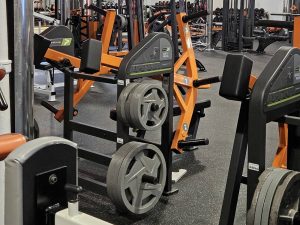
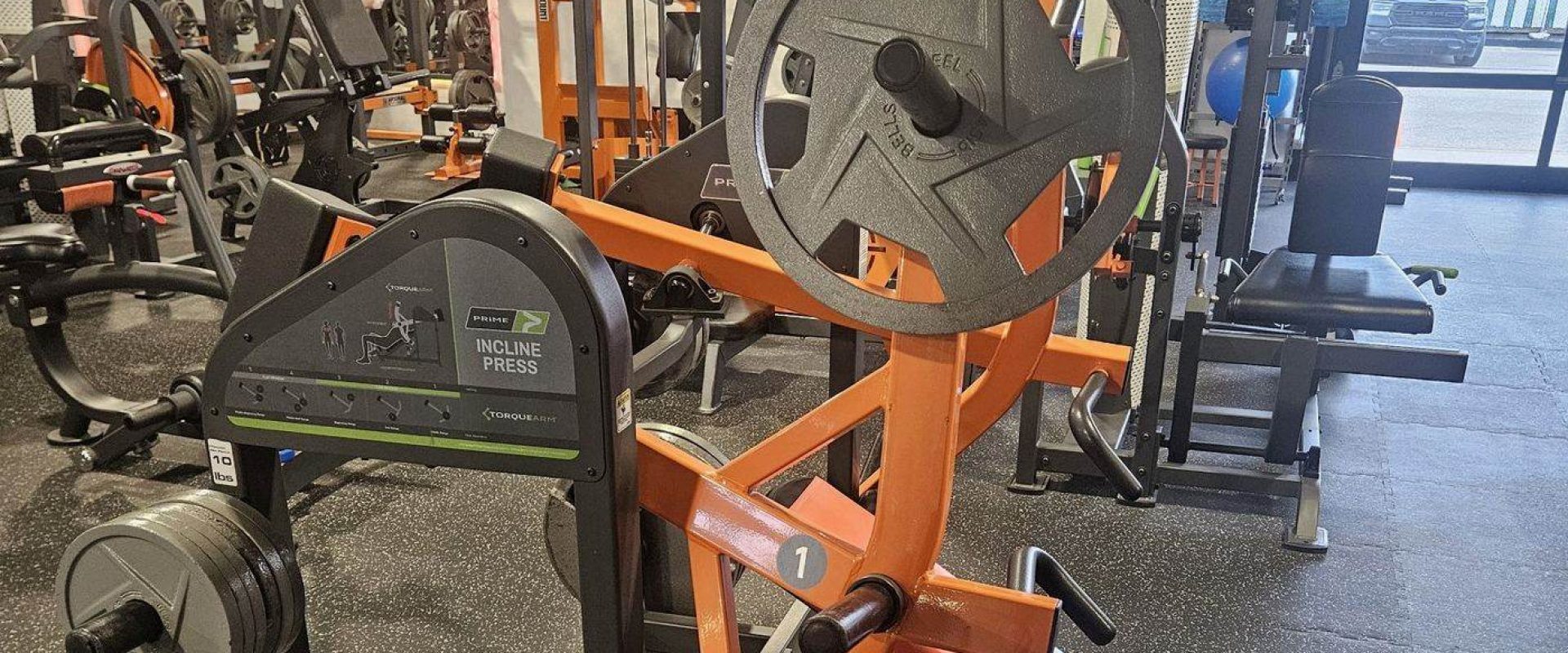
Prime Fitness USA’s plate-loaded machines have no cam and no lever. Their resistance curve is welded into the arm itself. Here is how three pegs give one machine five different reps, explained on the Prime incline press on our floor.

01Every machine has a strength curve
No exercise feels equally hard from start to finish. Your muscles produce more force in some joint positions than others, and the machine’s geometry decides where its load peaks. On most plate-loaded machines, that peak is fixed. You can change the weight, but you cannot change where the hardest part of the rep lands.
Prime spec Prime Fitness USA calls its answer SmartStrength. Its selectorized machines use a SmartCam with a lever. Its plate-loaded machines, in Prime’s words, have “no SmartCam.” Instead, “the manipulation of the resistance curve is achieved by their unique 3-peg torque arm design.”
That means the setting is not a dial you turn. The setting is which peg you load.
02Meet the Torque Arm
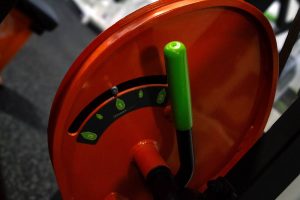
Look at the movement arm on our Prime incline press and you will find three loading horns, each stamped with a large number. They are not three storage pegs. Each one sits at a different angle and a different position relative to the pivot the arm rotates around.

Prime spec Prime’s chart assigns each peg a peak-resistance region:
| Setting | Plates go on | Peak resistance | Program |
|---|---|---|---|
| 1 | Peg 1 (middle peg) | Middle range. Behaves like a conventional machine. | 3 + 5 SET |
| 2 | Peg 2 | End range. Lighter off the bottom, heaviest at the lockout or squeeze. | 3 + 5 SET |
| 3 | Peg 3 | Beginning range. Heaviest in the stretch, easing off as you press. | 3 + 5 SET |
| 4 | Pegs 1 + 2, split | Middle + end. | 5 SET |
| 5 | Pegs 1 + 3, split | Middle + beginning. | 5 SET |
Source: Prime Fitness USA Torque Arm settings chart, matched line for line to the placard on our machine.
03Same plate, three different reps
Here is one plate moved across the three pegs on the same machine, photographed from the same spot. The machine, the seat and the weight do not change. Only the peg does.


Peak regions per Prime’s published chart. On our floor photographs of the Prime incline press.
04Why moving one peg changes everything
Our interpretation The physics are older than any gym. A plate does not get heavier or lighter as you lift it. What changes is its leverage: how far the plate sits from the pivot, measured sideways (horizontally). The further out it sits, the harder it pulls on the arm.
As the arm rotates through a rep, each peg’s horizontal distance from the pivot grows and shrinks. A peg reaches its maximum distance, and so its peak load, at one specific point in the arc. Prime angled the three pegs so that point falls early, in the middle, or late in the rep.
A simplified single-peg view. Prime does not publish force curves for its machines, so this shows the principle, not measured values. Our interpretation
05Settings 4 and 5: split loads
Prime spec The last two settings use two pegs at once. Setting 4 splits the plates between pegs 1 and 2 for a middle-plus-end profile. Setting 5 splits them between pegs 1 and 3 for middle-plus-beginning.
Our interpretation Each peg brings its own peak, so a split load spreads the effort across a longer stretch of the rep instead of concentrating it at one point.


Split loads on our incline press. On our floor
One detail Prime does not publish: how to divide the plates between the two pegs. Start with an even split, then adjust as you learn how the machine feels.
06The program is printed on the machine
This is the detail most people walk past. Our Prime incline press carries a placard with a settings chart, and the top row is not labelled “settings.” It is labelled as a workout sequence.

The 3-set program
One working set on each pure setting, in order: peg 1 (middle), peg 2 (end), peg 3 (beginning). Three sets, three different strength curves, one exercise.
The 5-set program
Run all five settings in sequence, adding the two split loads after the three pure ones.
Our interpretation Prime names the sequence but does not prescribe reps, rest or loading. That part is still on you and your coach.
07How to use it on the floor
- Set up the machine first. Seat, starting position and grip, the same as any plate-loaded press.
- Choose the setting, then the weight. Decide which part of the rep you want to train, then pick the peg.
- Learn the movement on peg 1. It behaves like a conventional machine, so it is the right place to learn the path.
- Expect the weight to change between pegs. The same plates will feel noticeably different on another peg. Adjust instead of forcing the number.
- Log the peg with the plates. Write “Peg 3 / 2 plates,” not just “2 plates.” Without the peg, the log does not tell you what you did.
- Load and unload with the arm at rest. Keep plates balanced and the movement arm settled before you change pegs.
08What the Torque Arm does not tell you
The system is genuinely useful, and it is also worth being clear about its limits.
- Prime does not publish force curves, so nobody outside Prime can say exactly how much heavier peg 3 is at the bottom than peg 1. We make no numerical claim.
- Prime does not publish a plate split for settings 4 and 5.
- No peer-reviewed study has tested the Torque Arm or SmartStrength settings directly.
- Prime’s marketing says SmartStrength yields more muscle fibre recruitment “from origin to insertion.” We have found no independent evidence for that claim, so we do not repeat it as fact.
What is clear is the mechanism. Moving the load changes the leverage, the leverage changes where the rep is hardest, and that gives a lifter a real, repeatable choice on every set.
09The Brickhouse perspective
Most plate-loaded machines give you one strength curve. The Prime machines on our floor give you five, and you choose one every time you load a plate. That is the kind of equipment we look for at Brickhouse: machines that reward lifters who understand what they are doing.
The same principle runs through Prime’s selectorized line, where a SmartCam lever does the job the pegs do here. Learn one system and you can use the other.
One-Week Full Access Pass
Seven days of 24/7 access to Brickhouse Gym, including every Prime plate-loaded machine on the floor. Commit within 7 days after your pass ends and the full $45.99 is credited toward your membership.
Get the passSources
Manufacturer / primary
- Prime Fitness USA, Smart Strength Technology (Plate Loaded Torque Arm settings chart)
- Prime Fitness USA, “Find Strength In Numbers, Find Your PRIME” (2016)
- Prime Fitness USA, Plate Loaded Pulldown product page (Smart Strength settings 1 to 5)
- Prime Fitness USA, Prodigy Smart Arm (3-pegged Torque Arm settings)
- Torque Arm placard on the Prime plate-loaded incline press at Brickhouse Gym
Independent / secondary
- Staffs Fitness, Prime Plate Loaded Low Back Extension (dealer description of the three-peg Torque Arm)